


FDA policy on compounded GLP-1 medicines is changing. We update this page when it does.
In short: Compounded semaglutide and tirzepatide are prepared by a pharmacy for an individual patient's prescription. They are not FDA-approved: according to FDA's compounding guidance, FDA doesn't verify their safety, effectiveness or quality, and they aren't generics. At Increase Health, a licensed provider decides whether a compounded medicine is appropriate for you. The questionnaire is the first step.
What is a compounded GLP-1?
A compounded medicine is prepared by a pharmacy rather than made by a drug company under an FDA approval. Most is prepared by a state-licensed pharmacy for one patient's prescription. Compounded semaglutide and compounded tirzepatide are made this way. In FDA's words: "Compounded drugs are not FDA-approved. This means that FDA does not verify the safety, effectiveness or quality of compounded drugs before they are marketed"13.
FDA also says compounded drugs "should only be used in patients whose medical needs cannot be met by an FDA-approved drug"12. That's why a prescriber, not a website, has to decide whether a compounded medicine is right for you.
How is it different from Wegovy, Ozempic, Zepbound or Mounjaro?
Those are FDA-approved brand medicines. FDA reviewed each one for safety, effectiveness and quality before it went on sale, and its label is based on large clinical trials of that exact product. Compounded versions skip that review. They are not generics either: generics are FDA-approved and shown to be therapeutically equivalent to the brand1.
FDA-approved medicine | Compounded medicine | |
|---|---|---|
Reviewed by FDA before sale | Yes | No1 |
Counts as a generic | Generics are FDA-approved | No1 |
Large clinical trials of that product | No controlled trials; data limited to small studies11 | |
Quality checked by | FDA, as part of approval1 | Mainly state boards of pharmacy, or FDA for outsourcing facilities (see below)13 |
How it usually comes | Prefilled pens (Wegovy also as tablets); Zepbound also in vials910 | Often multi-dose vials you draw up with a syringe4 |
This page uses Wegovy and Zepbound as the reference because their labels cover weight management. Ozempic and Mounjaro are approved for type 2 diabetes.
What this means for you: the safety information you read about semaglutide and tirzepatide comes from the FDA-approved medicines. It doesn't prove anything about a compounded product, good or bad. Your care team and its licensed providers will use it as the best available guide.
What do 503A and 503B mean?
They're the two sections of federal law that cover compounding. A 503A pharmacy is a state-licensed pharmacy that compounds for individual prescriptions, overseen mainly by its state board of pharmacy. A 503B outsourcing facility registers with FDA, must follow federal manufacturing standards, is inspected by FDA on a risk-based schedule, and must report adverse events13.
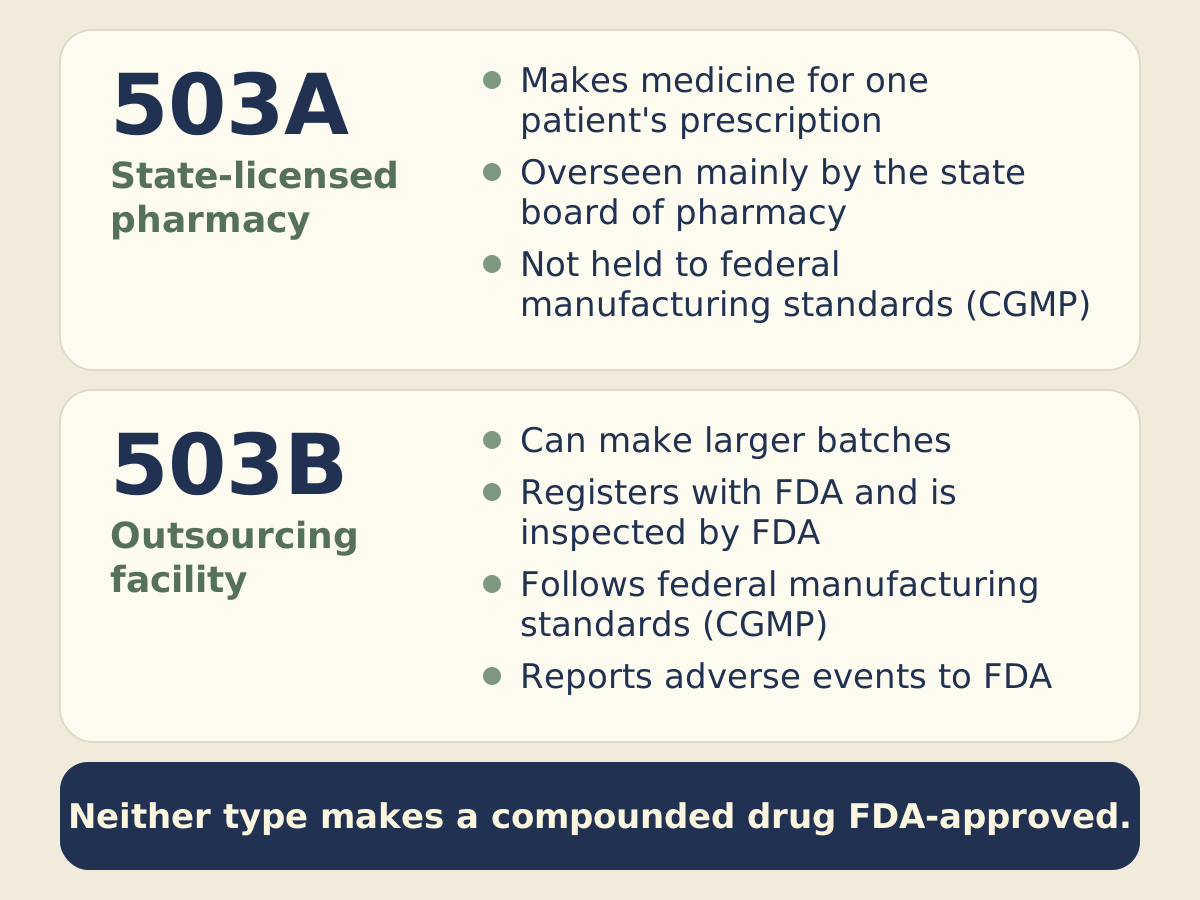
- 503A (state-licensed pharmacy): needs a prescription for an individual patient. Not held to federal manufacturing standards (called CGMP). Not required to report side effects to FDA23.
- 503B (outsourcing facility): follows CGMP and reports adverse events. Created by a 2013 law passed after a deadly 2012 outbreak of fungal meningitis linked to contaminated compounded injections3.
Neither type makes a compounded drug FDA-approved.
Can pharmacies still compound semaglutide and tirzepatide now the shortages are over?
Only under tighter conditions. FDA declared the tirzepatide shortage resolved in October 2024 and the semaglutide shortage resolved in February 2025. The grace periods for compounders ended in 2025. Compounding now has to meet the normal 503A or 503B rules, which limit copying approved drugs5. This is an area where FDA policy is still moving.
- Tirzepatide: shortage declared resolved 2 October 2024, confirmed 19 December 2024. The grace period ended in early 2025 and FDA's enforcement discretion ended after a court ruling in March 2025.
- Semaglutide: shortage declared resolved 21 February 2025. The grace period ran to 22 April 2025 for 503A pharmacies and 22 May 2025 for 503B facilities.
- 1 April 2026: FDA reminded compounders that a 503A pharmacy must compound for an individual prescription and may not regularly compound "essentially copies" of an approved drug. Adding an ingredient such as vitamin B12 doesn't automatically make a product different. FDA says it doesn't intend to act where a pharmacy fills four or fewer such prescriptions a month, or where a prescriber documents a significant difference for that patient5.
- 503B facilities: semaglutide and tirzepatide are not on the list of bulk ingredients outsourcing facilities may use, nor on FDA's shortage list5. On 30 April 2026 FDA proposed keeping them off that list. The comment period closed 30 July 2026, and no final decision had been published when we last checked67.
We'll update these lines as FDA's position changes.
What safety problems has FDA reported?
FDA has received reports of side effects with compounded semaglutide and tirzepatide. Because state-licensed pharmacies that aren't outsourcing facilities don't have to report them, FDA says "it is likely that adverse events from compounded versions of these drugs are underreported"2. It has also warned about dosing errors, salt forms, fake pharmacy labels and products sold "for research"24. These warnings don't mean every compounded product is unsafe. They're why the source matters.
- Dosing errors. People drawing from multi-dose vials have taken several times their intended dose. FDA's alert says "confusion between different units of measurement (e.g., milliliters, milligrams and 'units') may have contributed to dosing errors." Some people needed hospital care412. Always measure exactly as your label and provider instruct.
- Doses beyond the label. FDA has reports linked to compounded products prescribed at larger or more frequent doses, or faster increases, than the approved labels2.
- Salt forms. Some compounders have used semaglutide sodium or semaglutide acetate. FDA says these are different active ingredients from those used in the approved drugs and it knows of no lawful basis for compounding with them24.
- Fakes and "research" products. FDA has found labels naming pharmacies that don't exist, and products sold "for research purposes" or "not for human consumption". FDA urges people not to buy them, because they "are of unknown quality and may be harmful to their health"2.
- Added ingredients. FDA says adding vitamins such as B12 or B6, L-carnitine or NAD to semaglutide hasn't been shown to be safe and effective4.
- Quality studies. Lab tests have found impurities in some compounded samples. Their effect on patients is unknown, and several of these studies were written by scientists at the brand manufacturers131415. Studies of FDA's reporting database have found more reports of some problems with compounded products, but can't show cause and effect16.
How can I check a telehealth provider?
Use FDA's own red flags. A trustworthy service requires a screening and a prescription from a licensed prescriber, has a licensed clinician available after your medicine arrives, fills prescriptions at a state-licensed pharmacy, and never claims a compounded drug is "the same as" an FDA-approved one2. Check each point before you pay and when your medicine arrives.

Before you pay
- A licensed prescriber reviews your health history and writes a prescription before anything ships2.
- You can reach a licensed clinician with questions after your medicine arrives2.
- The service says plainly that compounded medicines are not FDA-approved, and never calls them "the same as", or a generic of, a brand drug12.
- Prices aren't "deep discounts" that seem too good to be true2.
- Nothing is sold "for research purposes" or "not for human consumption"2.
- The prescription is filled by a state-licensed pharmacy2. You can ask your care team whether the pharmacy is state-licensed, and in which state.
When your medicine arrives
- It arrives cold, with enough cold packs. Don't use an injectable GLP-1 that arrives warm. Contact your care team instead2.
- The packaging isn't broken, includes instructions, and looks like what you were told to expect2.
- The label has no spelling errors, and the pharmacy's name and address look right. You can look the pharmacy up with the board of pharmacy in the state where it's licensed2.
- The active ingredient isn't listed as a salt form, such as semaglutide sodium or acetate2. If you're not sure, ask your care team.
- You have the right syringe and know exactly how to measure your dose. If not, don't inject. Ask first4.
At Increase Health, a licensed provider reviews your intake and prescribes only if appropriate. If you're not approved, you're not charged. If you are, your medication ships to your door and you can message your care team about it, including questions about the pharmacy that filled it.
What people often get wrong
- "Compounded semaglutide is generic Wegovy." No. FDA says compounded drugs are not generics and are not FDA-approved1.
- "The FDA banned compounded GLP-1s" or "nothing changed when the shortage ended." Neither is right. Compounding is now limited to the normal 503A and 503B conditions, such as a prescription for an individual patient and not routinely copying approved drugs5.
- "Adding B12 makes it a different product." FDA's April 2026 update says a semaglutide and B12 product can still count as essentially a copy5.
- "A 'research use' vial is the same thing without the paperwork." FDA says these products are sold illegally, are of unknown quality and may be harmful2.
- "A warm package is fine if it's in date." FDA says not to use an injectable GLP-1 that arrives warm or without enough cold packs2.
When to get help
Chief Executive Officer & Co-founder
Deangelo studied Education Studies at UC San Diego and leads Increase Health’s patient education and community, making wellness information clear and accessible. He is not a clinician: your care team and its licensed providers will make every treatment decision.
Related treatments
For adults 18+ in eligible US states. Evaluation does not guarantee a prescription. Only approved patients receive medication; patients pay $0 if not approved. Compounded medications are not FDA-approved.

Compounded Semaglutide
Weekly injection. $447 for 3 months (about $149 a month).

Compounded Tirzepatide
Weekly injection. $669 for 3 months (about $223 a month).
Stylized product images for marketing purposes only; they do not reflect the actual label, size or number of the prescription containers.
Sources
- 1.
- 2.
- 3.
- 4.
- 5.
FDA. FDA clarifies policies for compounders as national GLP-1 supply begins to stabilize. Updated 2024–2026.
- 6.
FDA. FDA proposes to exclude semaglutide, tirzepatide, and liraglutide on 503B bulks list. 30 April 2026.
- 7.
Federal Register. Comment period extension notice. 26 June 2026.
- 8.
FDA. Declaratory order on the semaglutide injection shortage. 21 February 2025.
- 9.
Novo Nordisk. WEGOVY (semaglutide) Prescribing Information. DailyMed, 2026.
- 10.
Eli Lilly. ZEPBOUND (tirzepatide) Prescribing Information. DailyMed, 2026.
- 11.
Courtney LA et al. Compounded incretins in clinical practice: an opinion of the endocrine and metabolism practice and research network of the American College of Clinical Pharmacy. Diabetes Metab Syndr, 2025.
- 12.
Lambson JE et al. Administration errors of compounded semaglutide reported to a poison control center: case series. J Am Pharm Assoc, 2023.
- 13.
Hach M et al. Impact of manufacturing process and compounding on properties and quality of follow-on GLP-1 polypeptide drugs. Pharm Res, 2024. Authors employed by Novo Nordisk.
- 14.
Kopp KL et al. Impurities and potential immunogenicity associated with follow-on and compounded glucagon-like peptide-1 receptor agonists. Pharm Res, 2026. Authors affiliated with Novo Nordisk.
- 15.
Jordan B et al. A novel, widespread impurity in mass-compounded tirzepatide/B12 products: potential patient safety implications. Expert Opin Drug Saf, 2026. Authors affiliated with Eli Lilly.
- 16.
McCall KL et al. Safety analysis of compounded GLP-1 receptor agonists: a pharmacovigilance study using the FDA adverse event reporting system. Expert Opin Drug Saf, 2026.
This guide is general information and doesn't replace advice from your care team. Compounded medications are not FDA-approved; the FDA does not review them for safety, effectiveness or quality.
Related articles
How to give yourself an injection at home
Weight Management · 8 min read

What compounded GLP-1 treatment costs: semaglutide and tirzepatide
Weight Management · 5 min read

GLP-1 side effects: what to expect and when to get help
Weight Management · 8 min read