

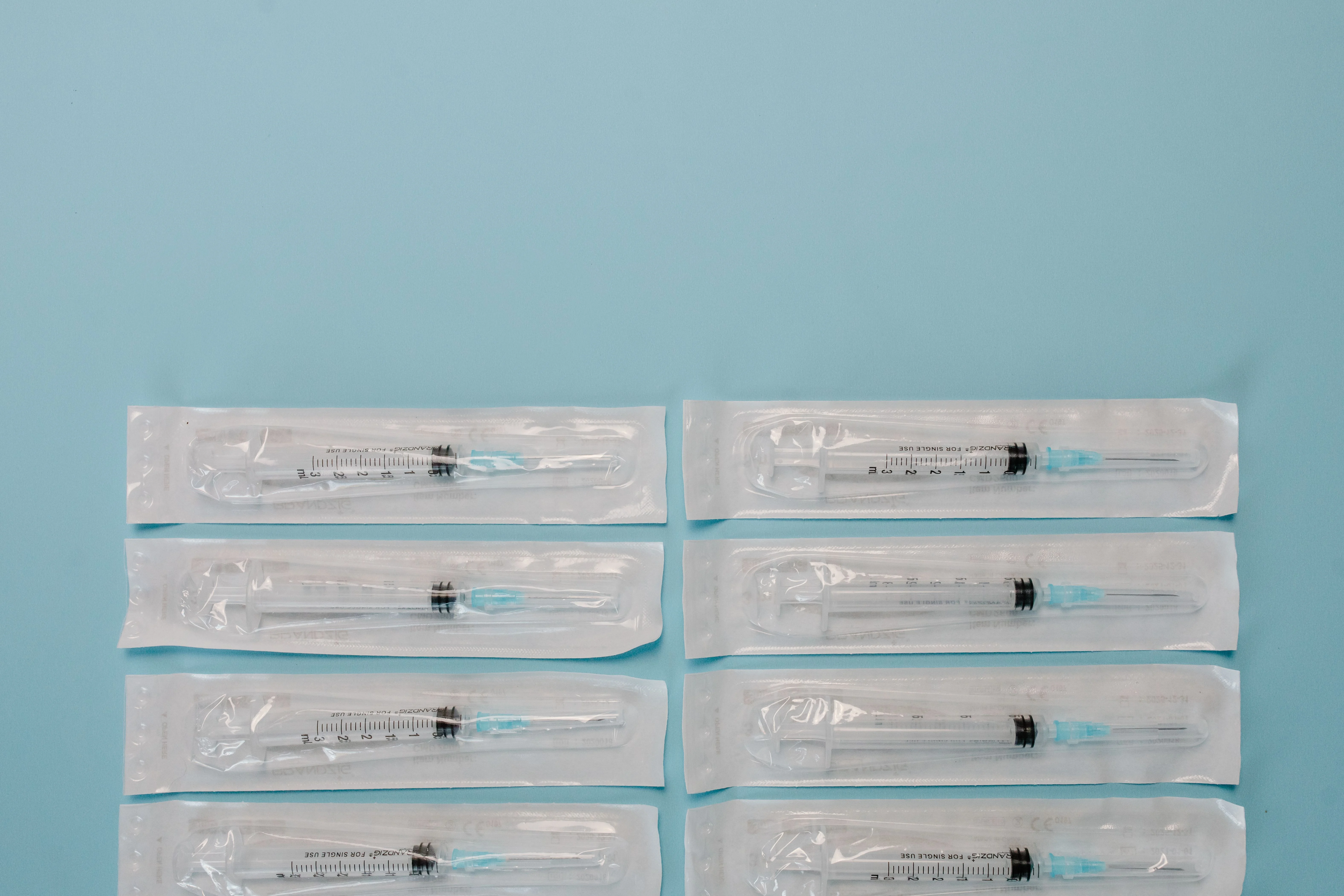
In short: Most injections we prescribe go just under the skin of your belly or thigh, drawn from a vial. Measure exactly the amount on your prescription label, use a new needle every time, change spots each time, and put used needles straight into a sharps container. If anything is unclear, don't inject: message your Increase Health care team first.
Units are not milligrams. On an insulin-style syringe, "units" measure how much liquid is in the syringe, not how much medicine. The same number of units can hold a very different amount of medicine depending on your vial. Never convert a dose yourself, and never assume a new vial works like your last one. If your label and your syringe don't obviously match, stop and ask.
Before you start
Your prescription label and the instructions in your box come first. If anything on this page differs from them, follow your label and ask your care team. Never guess a dose.
If you have any doubt about your dose, the medicine or the steps, don't inject. Message your care team first.
What do I need?
You need your medicine vial, a new syringe and needle for this dose, alcohol pads, clean gauze or a cotton ball, and a sharps container. Never reuse or share needles or syringes, even with family. A fresh needle is sterile and sharp, which keeps infections down and makes the injection more comfortable14.
- Your medicine vial
- A new syringe and needle for this dose
- Alcohol pads
- Clean gauze or a cotton ball
- A sharps container
How do I check my medicine is OK to use?
Check four things before every injection: the label matches your prescription, the date on the label hasn't passed, the liquid looks the way your label describes, and it has been kept as the label says. Don't use medicine that arrived warm or that looks cloudy, discoloured or has particles, unless your pharmacy says that's normal5.
- The label matches your prescription. Name and strength. Strength is usually written as milligrams per millilitre (mg/mL).
- The date hasn't passed. Compounded medicine has a beyond-use date on the label. Don't use it after that date, even if some is left.
- For compounded GLP-1 vials (semaglutide, tirzepatide): FDA recommends throwing a multi-dose vial away 28 days after you first use it, even if medicine is left and even if the label gives a later date. In FDA's words: "Do not continue using medication from the vial after 28 days, even if instructions from the compounder say the medication can be used for longer than 28 days"5. Write the date on the box the first time you use a vial.
- It looks right. Don't use it if it's cloudy, discoloured or has particles, unless your pharmacy says that's normal.
- It arrived cold. FDA "recommends patients not use any injectable GLP-1 drug that arrives warm or with insufficient refrigeration, as this can affect the drug's quality"5. Don't use it: message your care team, and keep the package so they can see it.
How do I measure my dose?
Fill the syringe to exactly the amount on your prescription label, using the syringe that came with your order. This is the step where most mistakes happen: FDA and poison control centres have reported people giving themselves many times their intended dose of compounded medicine from vials, usually because units, millilitres and milligrams were mixed up36. In one example from FDA's alert, patients told to give 5 units gave 50 units instead3.
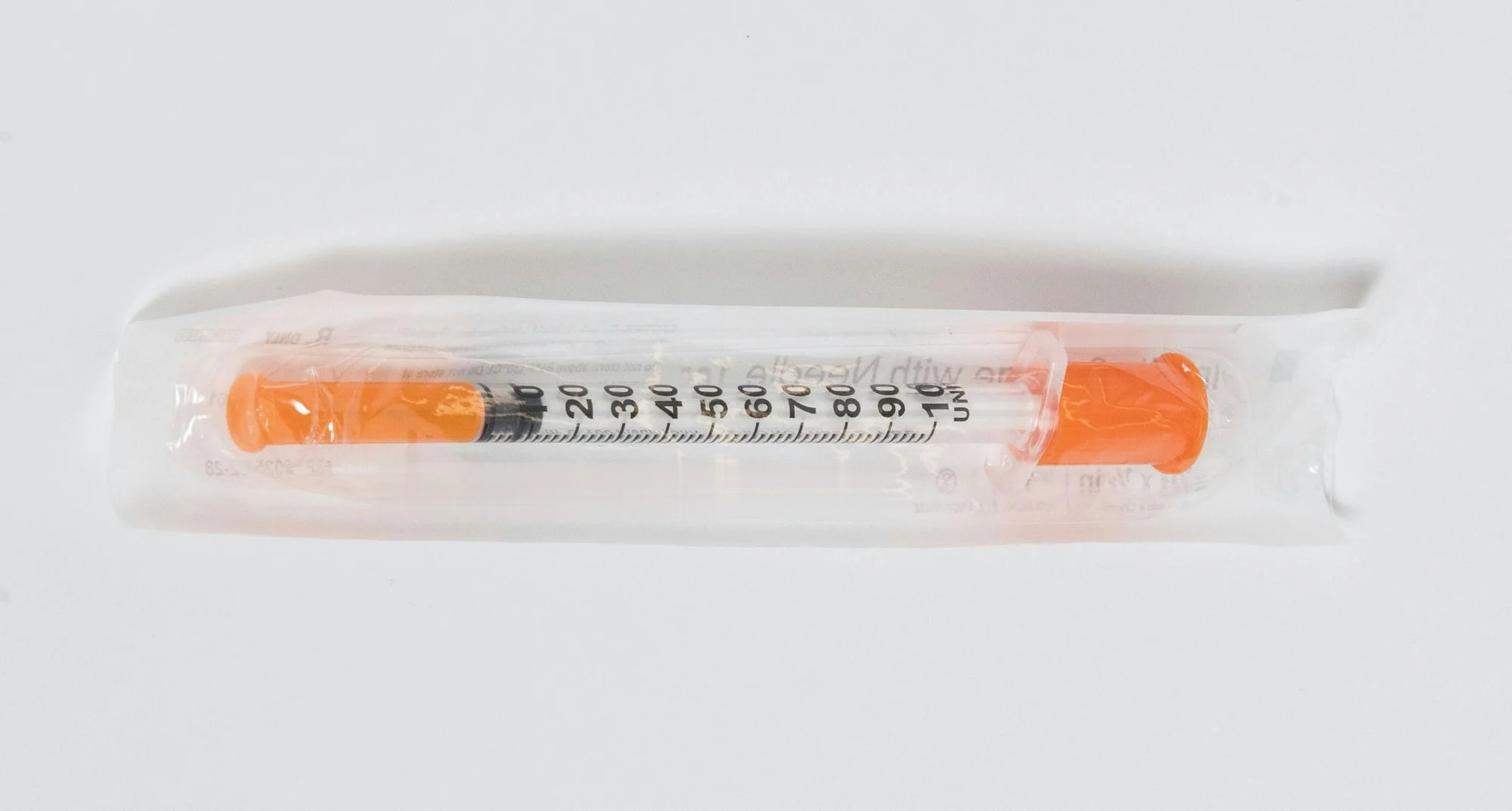
Don't ask a search engine or chatbot to work out your units. When we asked four popular AI assistants in October 2026 how to read the units on a syringe for compounded semaglutide, all four did the conversion arithmetic, and one offered a calculator. None of them can see your vial's strength. Only your label and your care team can.
- Your dose is set by your care team and its licensed providers. It's on your prescription label.
- On an insulin-style syringe, units are a measure of volume. How much medicine is in each unit depends on the strength of your vial, so the same dose can be a different number of units in a different vial.
- Before your first dose, make sure you know exactly which line on your syringe to fill to. If your instructions give your dose in a different measure from the markings on your syringe, or the syringe looks much bigger than your dose, stop and message your care team or pharmacy.
- If you get a new vial with a different strength, or your dose changes, check the line again before you inject.
How do I draw my dose from the vial?
Clean the rubber top, push in as much air as the dose you'll draw, turn the vial upside down and draw slowly to your line. Then clear any bubbles and check the amount again2.
- Wash your hands with soap and water and dry them. Work on a clean surface.
- If your label says to, let the vial reach room temperature first.
- Wipe the rubber top of the vial with an alcohol pad and let it dry.
- Take the cap off the needle without touching the needle.
- Pull the plunger back to the line for your dose, filling the syringe with air.
- Push the needle through the rubber top and push the air into the vial. This makes the medicine easier to draw out.
- Turn the vial upside down, keep the needle tip in the liquid, and slowly pull the plunger back to the line for your dose.
- Tap the syringe so any air bubbles rise, push them back into the vial, and check you still have the right amount.
- Pull the needle out of the vial. If you need to put the syringe down, recap the needle carefully.
Where should I inject?
Use the fatty layer of your belly, at least 2 inches from your belly button, or the front or outer thigh. The back of the upper arm works too, but it's easier if someone else does it. Use a different spot each time1.
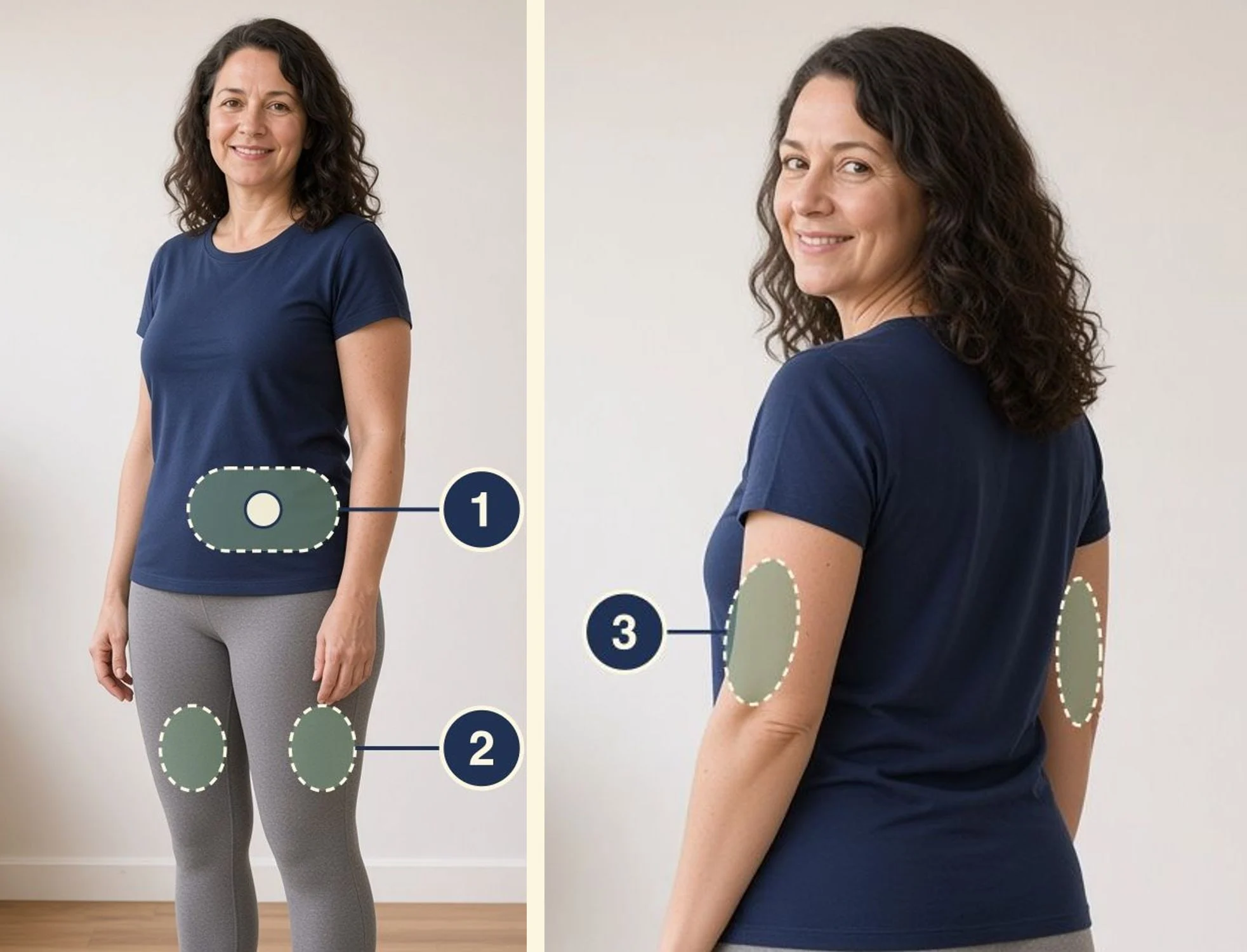
- Belly: at least 2 inches (5 cm) from your belly button.
- Thigh: the front or outer side, midway between your knee and hip.
- Back of the upper arm: easier if someone else gives the injection.
Avoid skin that is bruised, scarred, tender, red or hard.
Why do I need to change spots, and what are lumps under the skin?
Injecting in the same small area over and over can cause lumpy, thickened fat under the skin, called lipohypertrophy. In studies of people who inject insulin, it was common and closely linked to not rotating sites and reusing needles789. Medicine injected into a lump may not be absorbed the usual way.
- Move at least an inch from your last spot each time, and keep a note of where you injected. Some people work clockwise around the belly, or switch sides each week.
- Look at and feel your injection areas now and then. If you find a firm or rubbery lump, don't inject into it and tell your care team.
- This evidence comes from insulin injections; the same good habits apply to any injection under the skin.
How do I give the injection?
Clean the spot, pinch a fold of skin, insert the needle quickly and fully, then push the plunger down steadily. Put the needle straight into the sharps container1.
- Clean the spot with an alcohol pad and let it dry.
- Gently pinch about an inch of skin and the fat under it.
- Insert the needle quickly and fully, straight in (90 degrees). If you have very little fat there, your care team may suggest a 45-degree angle.
- Let go of the skin and push the plunger down steadily until the syringe is empty.
- Pull the needle straight out and put it in your sharps container right away.
- Press gauze on the spot for a few seconds if it bleeds. Don't rub.
- Wash your hands.
A little redness or a small bruise is common and usually settles in a day or two. Some injections sting; letting an alcohol-wiped spot dry fully first can help.
How do I get rid of used needles?
Put them in a sharps container straight away. Never put loose needles in the trash or recycling, and never flush them4.
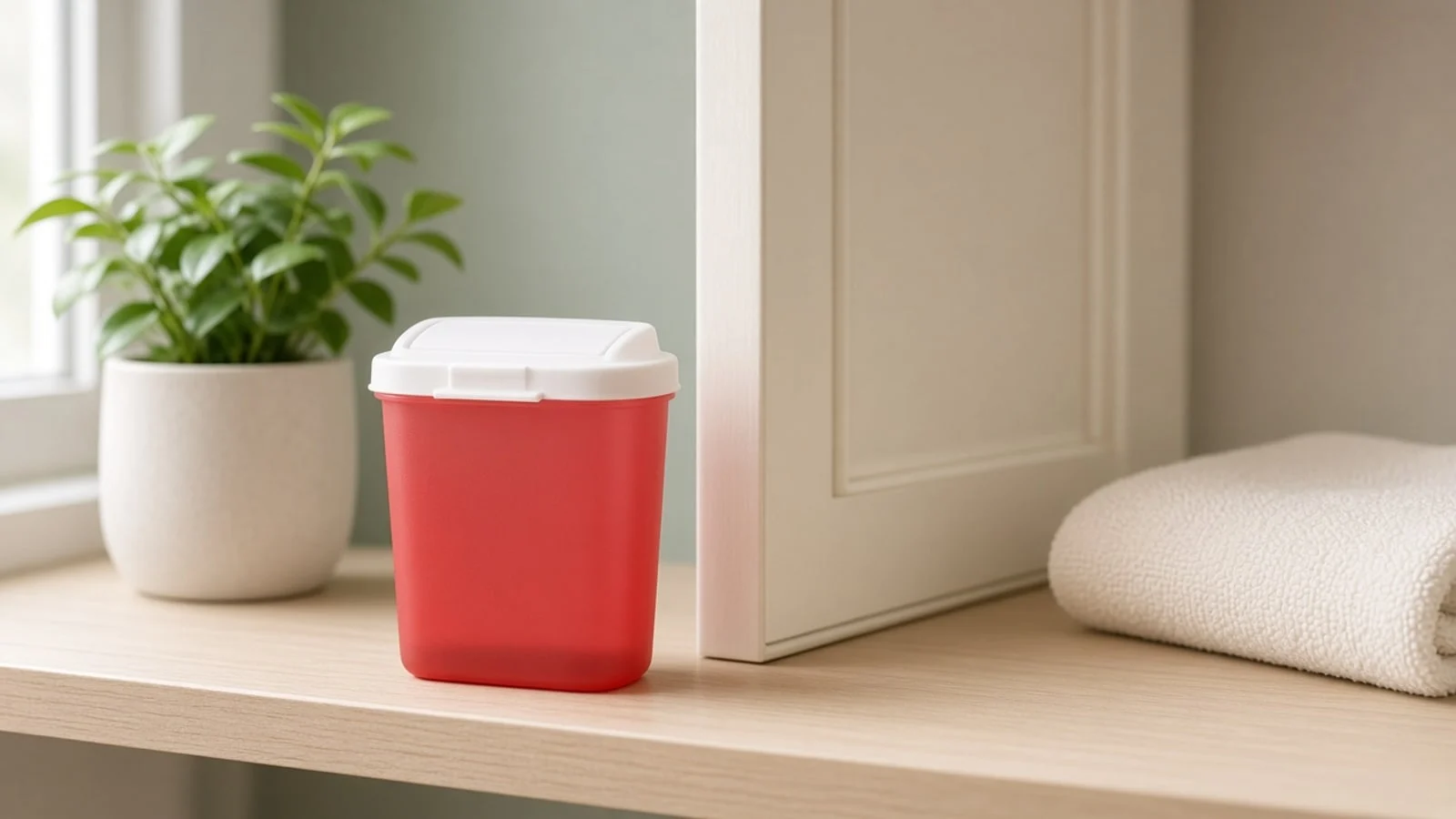
- If you don't have a sharps container, a heavy-duty plastic household container with a tight lid, such as a laundry detergent bottle, works.
- When the container is about three-quarters full, follow your local rules for disposal. Your pharmacy or local health department can tell you how.
- Keep it out of reach of children and pets.
How should I store my medicine?
Follow the storage instructions on your label. Most injectables are kept in the fridge and must not be frozen. Keep the vial in its box, away from light, if the label says so.
- Room-temperature rules printed for brand-name pens don't apply to compounded vials. Your vial follows its own label.
- Travelling: keep it with you, cool and out of direct sun, and don't put it in checked luggage where it could freeze or overheat. Ask your care team if you'll be away longer than your supply.
- Throw the vial away after the date on its label, or 28 days after first use for a compounded GLP-1 multi-dose vial, whichever comes first5.
What people often get wrong
- "25 units means 0.25 mg." Units measure liquid, not medicine. The conversion depends on your vial's strength, and getting it wrong is how the reported overdoses happened36.
- "My new vial works like my last one." A new vial can be a different strength. Check your label and the line on your syringe every time something changes.
- "It's fine as long as it's in date." FDA recommends throwing away a compounded GLP-1 multi-dose vial 28 days after first use, even if the label gives a later date, and not using one that arrived warm5.
- "Same spot every week is fine." Repeated injections in one spot are linked to lumps under the skin78.
When to get help
- Call 911 if you have signs of a severe allergic reaction: trouble breathing, swelling of your face, lips or throat, or feeling faint.
- If you think you took too much, call Poison Control at 1-800-222-1222, then message your care team. Don't wait for symptoms.
- Message your care team if redness, swelling, warmth or pain spreads around the injection site or doesn't go away, if you have a fever, if you find a lump where you inject, or if you have any question about your dose.
Adelaida Estrada-Cardenas, M.S.
Chief Strategy Officer & Co-founder
Adelaida holds a Master of Science and has advanced doctoral research training from the UC San Diego School of Biological Sciences and the Salk Institute for Biological Studies. She leads patient education at Increase Health. She is a scientist, not a licensed clinician: your care team and its licensed providers will make every treatment decision.
Related treatments
For adults 18+ in eligible US states. Evaluation does not guarantee a prescription. Only approved patients receive medication; patients pay $0 if not approved. Compounded medications are not FDA-approved.

Compounded Semaglutide
GLP-1 injection

Compounded Tirzepatide
GLP-1 + GIP injection
Stylized product images for marketing purposes only; they do not reflect the actual label, size or number of the prescription containers.
Sources
- 1.
MedlinePlus, Subcutaneous (SQ) injections
- 2.
MedlinePlus, Drawing medicine out of a vial
- 3.
- 4.
- 5.
- 6.
Lambson JE et al. Administration errors of compounded semaglutide reported to a poison control center: case series. J Am Pharm Assoc. 2023.
- 7.
Frid AH et al. New insulin delivery recommendations. Mayo Clin Proc. 2016.
- 8.
Blanco M et al. Prevalence and risk factors of lipohypertrophy in insulin-injecting patients with diabetes. Diabetes Metab. 2013.
- 9.
Zhang Q et al. Prevalence of insulin injection-induced lipohypertrophy detected by ultrasound: a systematic review and meta-analysis. BMC Public Health. 2026.
This guide is general information and doesn't replace the instructions from your care team or pharmacy. Compounded medications are not FDA-approved; the FDA does not review them for safety, effectiveness or quality.
Related articles

Compounded GLP-1s vs FDA-approved: what's different
Weight Management · 9 min read

What compounded GLP-1 treatment costs: semaglutide and tirzepatide
Weight Management · 5 min read

GLP-1 side effects: what to expect and when to get help
Weight Management · 8 min read