


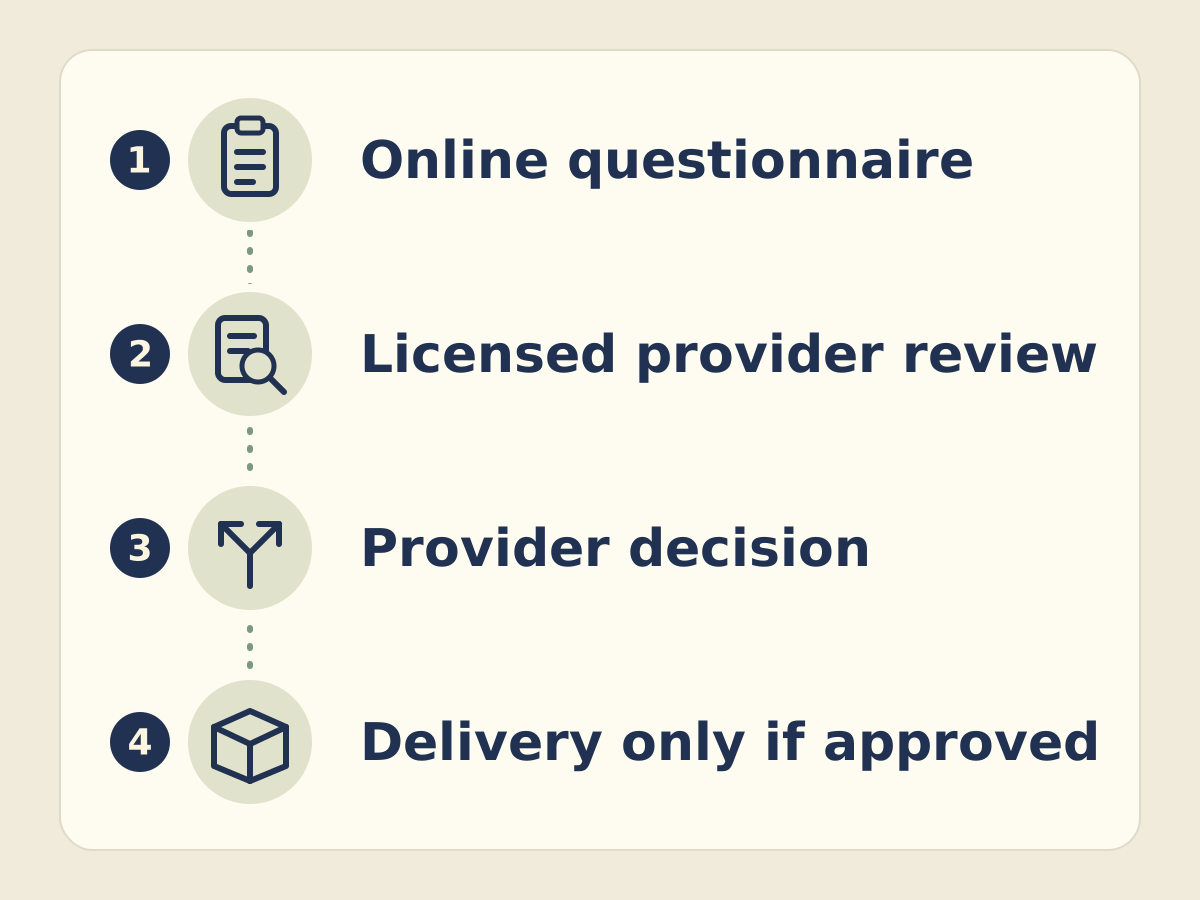
In short: Increase Health's GLP-1 weight management program is for adults 18 and over in a state our provider network covers, usually with a BMI of 30 or more, or 27 or more with a weight-related health condition. A licensed provider reviews your intake and decides. If you're not approved, you're not charged. The questionnaire is the next step.
Who qualifies for GLP-1 weight management treatment online?
To be considered, you need to be 18 or older, live in a state the network covers, and usually have a BMI of 30 or more, or 27 or more with a weight-related condition. You can't have a personal or family history of medullary thyroid cancer or MEN 2, and you can't be pregnant or breastfeeding.
Meeting those points means a provider will review your intake, not that you'll be prescribed. The provider weighs your whole health history and medicines, and prescribes only if treatment is appropriate for you.
Increase Health's providers prescribe compounded semaglutide and compounded tirzepatide. Compounded medications are not FDA-approved, and FDA does not review them for safety, effectiveness or quality10. The safety facts on this page come from the FDA labels and trials of the approved medicines, Wegovy and Zepbound12.
Where do the BMI 30 and 27 numbers come from?
They come from the trials behind the FDA-approved medicines. The main Wegovy and Zepbound trials (STEP 1 and SURMOUNT-1, both in the New England Journal of Medicine) enrolled adults with a BMI of 30 or more, or 27 to under 30 with at least one weight-related condition1234. The labels describe this as obesity, or overweight with a weight-related condition. Prescribers use the same lines.
Weight-related conditions in those trials included high blood pressure, high cholesterol, obstructive sleep apnea and cardiovascular disease.
So if your BMI is between 27 and 30 with no weight-related condition, or under 27, a provider will usually say this treatment isn't right for you now. These medicines were studied as long-term treatment for excess weight that affects health, not for a few pounds before an event.
What does the intake ask, and why?
Every question maps to something in the labels or to a safety judgment the provider has to make. Answer honestly and completely. A question you skip or soften is a risk the provider can't see. You'll be asked to confirm that your answers are accurate before you submit.
The intake asks about | Why your care team needs to know |
|---|---|
Your date of birth | The program is for adults 18 and over. |
Height and weight | |
Your state | The provider on your care team must be licensed where you live. Some states require a short video visit before a prescription. |
Pregnancy, breastfeeding and pregnancy plans | The labels say these medicines aren't used in pregnancy, and Wegovy's says to stop at least 2 months before a planned pregnancy12. |
Health conditions | Thyroid cancer history and MEN 2 are a firm "no" on the labels. Pancreatitis, gallbladder disease, stomach and bowel conditions such as gastroparesis, kidney and liver problems, and eating disorders all carry warnings or need extra caution1268. |
Medicines and supplements | Insulin or sulfonylureas raise the risk of low blood sugar. Birth control pills may work less well with Zepbound. These medicines shouldn't be combined with another GLP-112. |
Allergies | A past serious allergic reaction to the medicine or its ingredients rules it out12. |
Alcohol | It's part of judging your overall risk. |
Current or past GLP-1 use | So your care team knows where you're starting from. |
Photo ID | To confirm who you are. |
Your care team will also want to know about any upcoming surgery or sedation, and, if you have type 2 diabetes, any diabetic eye disease, because both labels carry warnings about them12.
Can I take a GLP-1 if I'm pregnant, breastfeeding or planning a pregnancy?
No. Increase Health doesn't treat anyone who is pregnant, breastfeeding or planning a pregnancy. The Wegovy and Zepbound labels say weight reduction offers no benefit in pregnancy and may harm the baby, so the medicine should be stopped once a pregnancy is recognized12. Wegovy's label adds a planning step.
- Planning a pregnancy: the Wegovy label says to stop "at least 2 months before a planned pregnancy because of the long half-life of semaglutide", meaning it stays in the body a long time1. Tell your care team about your plans before you start, not after.
- Birth control pills: the Zepbound label warns that tirzepatide may make birth control pills less effective, especially in the first weeks and after each dose increase. It suggests switching to a non-pill method, or adding a barrier method, during those times2. Tell your care team which method you use.
- If you become pregnant during treatment: stop and contact your care team and your own doctor.
Does a history of thyroid cancer rule me out?
A personal or family history of medullary thyroid carcinoma (MTC), or a personal history of MEN 2, rules these medicines out. That's a contraindication on both FDA labels12. It comes from a boxed warning: these medicines caused thyroid C-cell tumors in rodents. Whether that happens in people isn't known12.
MTC is one specific type of thyroid cancer. Other thyroid cancers and thyroid conditions are different, but your care team still needs your full history and may ask for records. If you're being treated for any cancer now, start the conversation with your cancer care team.
Why might a provider say no?
The most common reasons are a BMI below the range, a label contraindication, pregnancy or pregnancy plans, or a condition that needs in-person care first. Some are firm label lines. Others are the provider's judgment about whether online treatment is safe for you. A "no" is a medical decision, not a verdict on you.
Reason | What it means |
|---|---|
BMI under 27, or 27 to 30 with no weight-related condition | The medicine isn't indicated for you now34. Your own doctor can talk through other options. |
Personal or family history of MTC, or MEN 2 | |
Past serious allergic reaction to the medicine or its ingredients | A label contraindication12. Both labels also advise caution after a serious reaction to a different GLP-1. |
Pregnant, breastfeeding or planning a pregnancy | |
Severe gastroparesis or another significant stomach or bowel condition | The labels don't recommend these medicines in severe gastroparesis12. |
Past pancreatitis | Not a label contraindication, but experts urge caution and the research is mixed67. Many providers want this handled in person. |
Untreated gallbladder, kidney or liver problems | These need care first. The labels warn about gallbladder disease and kidney injury12. |
An active eating disorder | Experts advise screening, because appetite-suppressing medicines may make restriction worse89. |
Answers that need an exam or more information | The provider may ask for records or suggest you see your own doctor first. |
Your state isn't covered | Not a medical decision. The network can only treat where its providers are licensed. |
What happens if I'm not approved?
You're not charged. Your card is authorized at checkout and charged only if a provider approves your prescription. If the provider decides treatment isn't right for you, you pay $0, and nothing renews because there's no subscription. Often the next step is a conversation with your own doctor.
If you are approved, one payment covers 3 months, your medication ships to your door, and you can message your care team. Klarna's 4 interest-free payments are available at checkout.
What people often get wrong
- "If my BMI qualifies, I'll be approved." BMI is only the starting point. Providers also decline for thyroid cancer history, past serious allergy, severe gastroparesis, pregnancy or pregnancy plans, and, as a matter of judgment, past pancreatitis or an active eating disorder1269.
- "Leaving something off the intake is harmless." The questions follow the label warnings. A provider can't protect you from a risk they don't know about, and a skipped answer can lead to a prescription that isn't safe for you.
- "Pregnancy is the only timing that matters." The Wegovy label says to stop at least 2 months before a planned pregnancy, so plans matter as much as a current pregnancy1.
- "Birth control works the same." The Zepbound label warns that birth control pills may work less well, especially in the first weeks and after dose increases2.
- "GLP-1s carry a suicide warning, so any mental health history rules me out." FDA removed that warning in January 2026 after a review of 91 trials found no increased risk5. Your care team and its licensed providers will still ask about mood, mental health and eating, and decide case by case.
When to get help
- Call 911 for signs of a severe allergic reaction: trouble breathing, or swelling of your face, lips or throat.
- Get urgent care for severe stomach pain that won't go away, with or without vomiting. It can be a sign of pancreatitis12.
- Tell your care team about a lump or swelling in your neck, trouble swallowing, or hoarseness that doesn't go away12, or about new or worsening low mood. If you have thoughts of harming yourself, call or text 9885.
Adelaida Estrada-Cardenas, M.S.
Chief Strategy Officer & Co-founder
Adelaida holds a Master of Science and has advanced doctoral research training from the UC San Diego School of Biological Sciences and the Salk Institute for Biological Studies. She leads patient education at Increase Health. She is a scientist, not a licensed clinician: your care team and its licensed providers will make every treatment decision.
Related treatments
For adults 18+ in eligible US states. Evaluation does not guarantee a prescription. Only approved patients receive medication; patients pay $0 if not approved. Compounded medications are not FDA-approved.

Compounded Semaglutide
Weekly injection. $447 for 3 months (about $149 a month).

Compounded Tirzepatide
Weekly injection. $669 for 3 months (about $223 a month).
Stylized product images for marketing purposes only; they do not reflect the actual label, size or number of the prescription containers.
Sources
- 1.
Novo Nordisk. WEGOVY (semaglutide) Prescribing Information. DailyMed, 2026.
- 2.
Eli Lilly. ZEPBOUND (tirzepatide) Prescribing Information. DailyMed, 2026.
- 3.
Wilding JPH et al. Once-weekly semaglutide in adults with overweight or obesity. N Engl J Med, 2021.
- 4.
Jastreboff AM et al. Tirzepatide once weekly for the treatment of obesity. N Engl J Med, 2022.
- 5.
FDA. FDA requests removal of suicidal behavior and ideation warning from GLP-1 receptor agonist medications. Drug Safety Communication, 13 January 2026.
- 6.
Gorgojo-Martínez JJ et al. Clinical recommendations to manage gastrointestinal adverse events in patients treated with GLP-1 receptor agonists: a multidisciplinary expert consensus. J Clin Med, 2022.
- 7.
Nassar M et al. Use of glucagon-like peptide-1 receptor agonists in people with history of acute pancreatitis: TriNetX analysis. Diabetes Metab, 2025.
- 8.
Mozaffarian D et al. Nutritional priorities to support GLP-1 therapy for obesity: a joint advisory (ACLM, ASN, OMA and The Obesity Society). Am J Clin Nutr, 2025.
- 9.
Škudar S. Eating disorders in the GLP-1 era: a spotlight on emerging clinical risks, research gaps, and practice priorities. Int J Eat Disord, 2026.
- 10.
This guide is general information and doesn't replace advice from your care team. Completing the intake doesn't guarantee a prescription. Compounded medications are not FDA-approved; the FDA does not review them for safety, effectiveness or quality.
Related articles
How to give yourself an injection at home
Weight Management · 8 min read

Compounded GLP-1s vs FDA-approved: what's different
Weight Management · 9 min read

What compounded GLP-1 treatment costs: semaglutide and tirzepatide
Weight Management · 5 min read