


In short: Peptides labelled "research use only" aren't made or checked for people, and FDA treats them as unapproved drugs when they're sold for human use. At Increase Health, a licensed provider reviews your intake, and a state-licensed pharmacy dispenses anything prescribed. Compounded peptides aren't FDA-approved either, so that oversight matters. Start with the peptide therapy questionnaire.
What does "research use only" mean on a peptide?
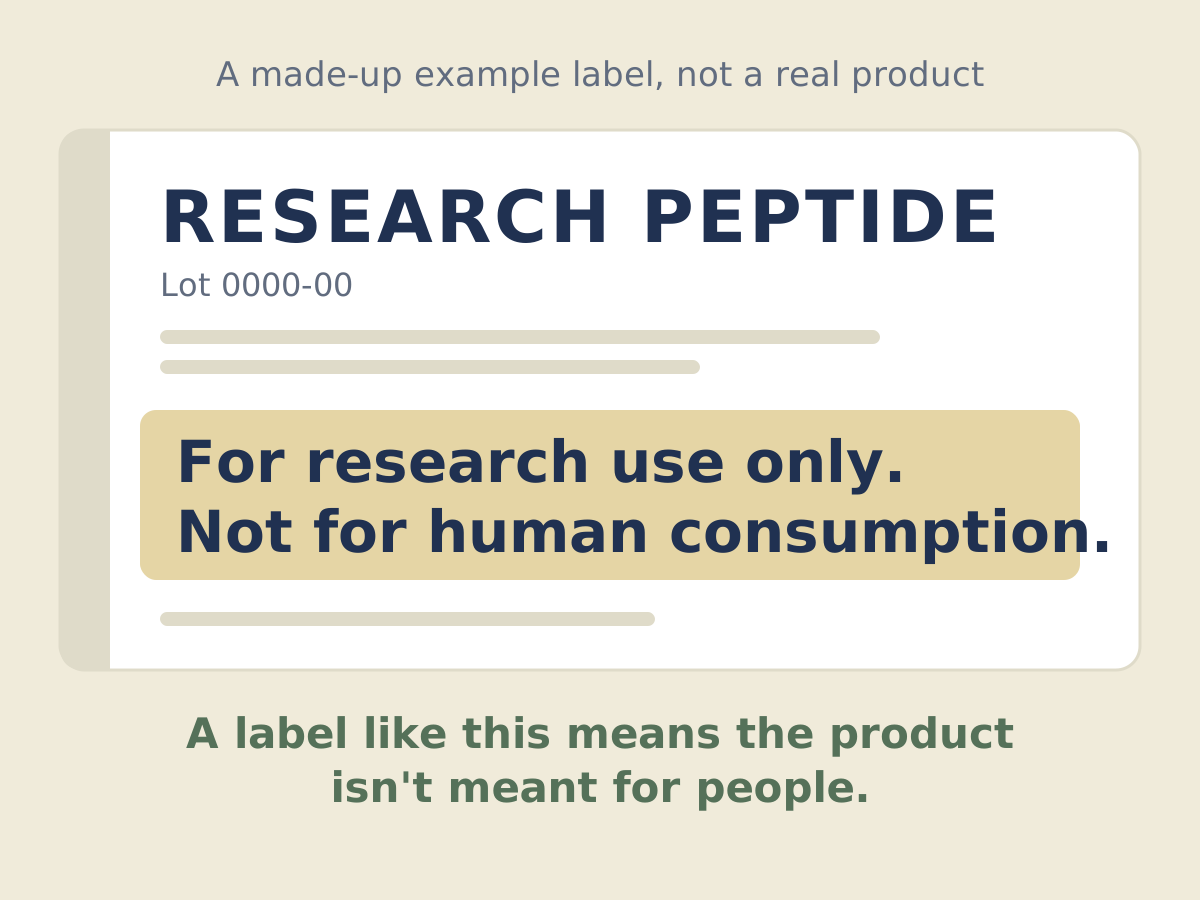
It means the seller says the product is for lab research, not for people. FDA doesn't treat that label as a shield. When a website shows a product is really meant for human use, FDA treats it as an unapproved new drug, and it has sent warning letters to online peptide sellers on that basis from 2024 to 20261234.
In those letters, FDA pointed to signs that the products were meant for people: dosing guides, "peptide calculators", and bacteriostatic water sold alongside the vials for mixing injections. FDA said that water is itself a drug when it's sold for that purpose34. FDA's patient page on unapproved GLP-1 drugs also warns about products sold "for research purposes" or "not for human consumption", and urges people not to buy them because they "are of unknown quality and may be harmful to their health"5.
A research-use product has no prescriber checking whether it's right for you, no pharmacy label with directions, and no one answerable for what's in the vial.
How is a prescribed peptide different?
A prescribed peptide starts with a licensed provider reviewing your health history and deciding whether it's appropriate. If it is, a pharmacy prepares and dispenses it for you, with a label. It is still a compounded medication. Compounded medications are not FDA-approved, and FDA does not review them for safety, effectiveness or quality before they're sold6.
So a prescription doesn't make a peptide FDA-approved. What it adds is a person who checks your health first, and a pharmacy that works under compounding rules. Federal law sets out two compounding settings6:
- 503A pharmacies are state-licensed and overseen mainly by state boards of pharmacy.
- 503B outsourcing facilities register with FDA and must follow federal manufacturing standards.
A 503A pharmacy can compound from a bulk ingredient only if it meets federal tests, and the ingredient needs a certificate of analysis and an FDA-registered manufacturer7. A research-chemical seller works outside both settings.
What have tests of peptides bought online found?
The few published tests are worrying. Semaglutide vials bought from illegal online pharmacies all contained endotoxin, a contaminant from bacteria, and were far less pure than claimed. Melanotan II vials from online shops held less peptide than labelled, and some had unknown impurities. The samples were small, but the label didn't match the vial89.
What each study looked at:
- Semaglutide, 2024. Researchers ordered from illegal online pharmacies. Only a few vials arrived; the pen orders never came. Every vial tested contained endotoxin, and purity was far below the level claimed8.
- Melanotan II, 2015. Vials from three online shops contained less peptide than the label said. Vials from two of the shops had impurities the researchers couldn't identify9.
- Black-market growth-hormone products, 2018. Testing found modified molecules that had never been characterised10.
- "Research chemicals" that aren't peptides, 2017. Of products sold online as SARMs, only about half contained one. A quarter contained substances not on the label, and fewer than half matched the labelled amount11.
We found no published tests of online sermorelin or NAD+ specifically.
What do FDA's compounding categories mean?
Some ingredients aren't part of an FDA-approved drug and have no official quality standard. A 503A pharmacy can compound those only if they're on FDA's final bulks list. While FDA decides, it sorts nominated substances into three interim categories. Being in Category 1 means "under evaluation". It is not FDA approval712.
Category | What it means in plain words |
|---|---|
1 | Under evaluation. FDA doesn't intend to act against compounding with it if certain conditions are met. Not approval, and not a place on the final list |
2 | FDA has identified significant safety risks. FDA may act against compounding with it |
3 | Nominated without enough supporting information |
NAD is in Category 112. That means FDA is still evaluating it. A category can change, and we'll update this page if it does.
What happened with BPC-157?
BPC-157 was in Category 2, the group FDA flagged for significant safety risks. Its nominators later withdrew it, so FDA now lists it as "nominated but withdrawn". FDA still states its concerns: possible immune reactions, peptide-related impurities, and little or no safety information for the proposed routes13. Increase Health doesn't offer BPC-157.
Several other peptides sold online sit on the same withdrawn list13. Being taken off a list is not FDA approval, and neither is being discussed by an FDA advisory committee. Human evidence is also thin: a 2025 systematic review found almost all BPC-157 studies were in animals or labs, with no clinical safety data14.
Which peptides does Increase Health offer?
Increase Health's peptide therapy range has two treatments: sermorelin, for growth hormone support, and NAD+, as an injection or a nasal spray. A licensed provider prescribes them only if they're appropriate after reviewing your intake. Both are compounded, so neither is FDA-approved, and FDA does not review them for safety, effectiveness or quality6.
- Sermorelin is a lab-made version of part of the hormone that signals your pituitary gland to release your body's own growth hormone15. It was once sold as an FDA-approved medicine, Geref, for a diagnostic test and for children with a specific growth hormone deficiency. It was discontinued in 2008, and FDA determined it was not withdrawn for reasons of safety or effectiveness16. Sermorelin prescribed today is compounded. $489 for 3 months.
- NAD+ is a molecule your cells use in many chemical reactions. It's in Category 1, and human evidence for injections and nasal spray is limited; our NAD+ evidence guide explains what's known. $582 for 3 months (injection) or $510 (nasal spray).
How it works: you complete an online intake, and a licensed provider reviews it. If it's appropriate, you're prescribed and pay once for 3 months. Your card is authorised at checkout and charged only if a provider approves; if you're not approved, you pay $0. There's no subscription and nothing auto-renews. Klarna's 4 interest-free payments are available. Your medication ships to your door, and you can message your care team. Prices as of September 2026.
How can you tell a peptide isn't meant for people?
Look at what the seller asks you and what arrives in the box. A peptide meant for people involves a prescriber who reviews your health and a pharmacy that labels it for you. If nobody asks about your health and the label says "research use only", the product isn't meant for you to inject or use.
Signs a peptide isn't meant for people
- The label or website says "research use only", "for research purposes" or "not for human consumption"15.
- You can buy without a prescription or any health questions5.
- The seller offers "peptide calculators", dosing charts, or mixing water alongside the vials34.
- Dosing advice comes from forums, videos or the seller's blog, not from a prescriber.
- Payment is cryptocurrency only, or another method that's hard to trace or refund.
- The seller says it's "the same as" an FDA-approved medicine, or the price seems too good to be true5.
- There's no licensed prescriber you can reach after you buy5.
What a prescribed peptide comes with
- A licensed provider who reviews your health history and medications before deciding.
- A prescription, written only if it's appropriate for you.
- Medication prepared and dispensed by a state-licensed pharmacy.
- A pharmacy label with your name, the medication, directions and a beyond-use date.
- A care team you can message with questions or side effects.
- An honest caveat: compounded peptides are still not FDA-approved6.
FDA's own advice is to get a prescription from a licensed provider and fill it at a state-licensed pharmacy5.
What people often get wrong
- "Research peptides are the same thing with a different label." FDA treats them as unapproved drugs when they're sold for people. Tests of online peptides have found less peptide than labelled, unknown impurities and endotoxin189. The name on the vial doesn't tell you what's inside.
- "Prescribed means FDA-approved." Compounded peptides, including ours, are not FDA-approved. FDA doesn't review them for safety, effectiveness or quality before they're sold6.
- "Category 1 means FDA approved it." Category 1 means under evaluation. It's an interim policy, not approval712.
- "BPC-157 has been cleared." Its nominators withdrew it from category review. FDA still lists its safety concerns13.
When to get help
- Call 911 if you have trouble breathing, swelling of your face, lips or throat, chest pain, or you feel faint.
- If you think you took too much of anything, or a child got into a vial, call Poison Control at 1-800-222-1222.
- If you've injected a product bought online and you get a fever, chills, spreading redness or feel very unwell, get medical care promptly and take the vial with you.
- Increase Health patients: message your care team about side effects or questions. Don't use messages for emergencies.
Chief Executive Officer & Co-founder
Deangelo studied Education Studies at UC San Diego and leads Increase Health’s patient education and community, making wellness information clear and accessible. He is not a clinician: your care team and its licensed providers will make every treatment decision.
Related treatments
For adults 18+ in eligible US states. Evaluation does not guarantee a prescription. Only approved patients receive medication; patients pay $0 if not approved. Compounded medications are not FDA-approved.

Sermorelin
Injection under the skin. $489 for 3 months.

NAD+
Injection ($582) or nasal spray ($510), for 3 months.
Stylized product images for marketing purposes only; they do not reflect the actual label, size or number of the prescription containers.
Sources
- 1.
FDA, Warning letter to an online peptide seller (10 December 2024)
- 2.
FDA, Warning letter to an online peptide seller (26 February 2025)
- 3.
FDA, Warning letter to an online peptide seller (31 March 2026)
- 4.
FDA, Warning letter to an online peptide seller (24 August 2026)
- 5.
- 6.
- 7.
FDA, Bulk Drug Substances Used in Compounding Under Section 503A of the FD&C Act (updated 14 May 2026)
- 8.
- 9.
Breindahl et al., Drug Test Anal 2015. Identification and characterization by LC-UV-MS/MS of melanotan II skin-tanning products sold illegally on the Internet
- 10.
Krug et al., Growth Horm IGF Res 2018. Analysis of new growth promoting black market products
- 11.
Van Wagoner et al., JAMA 2017. Chemical Composition and Labeling of Substances Marketed as Selective Androgen Receptor Modulators and Sold via the Internet
- 12.
FDA, Bulk Drug Substances Nominated for Use in Compounding Under Section 503A (PDF, updated 14 May 2026)
- 13.
FDA, Certain Bulk Drug Substances for Use in Compounding that May Present Significant Safety Risks (current as of 22 April 2026)
- 14.
Vasireddi et al., HSS J 2025. Emerging Use of BPC-157 in Orthopaedic Sports Medicine: A Systematic Review
- 15.
Prakash & Goa, BioDrugs 1999. Sermorelin: a review of its use in the diagnosis and treatment of children with idiopathic growth hormone deficiency
- 16.
Federal Register, Determination that Geref (sermorelin acetate) was not withdrawn from sale for reasons of safety or effectiveness (4 March 2013)
This guide is general information and doesn't replace advice from your care team. Compounded medications are not FDA-approved; the FDA does not review them for safety, effectiveness or quality.
Related articles

NAD+ injections and nasal spray: what the evidence says
Peptides · 6 min read
How to give yourself an injection at home
Weight Management · 8 min read

Compounded GLP-1s vs FDA-approved: what's different
Weight Management · 9 min read