


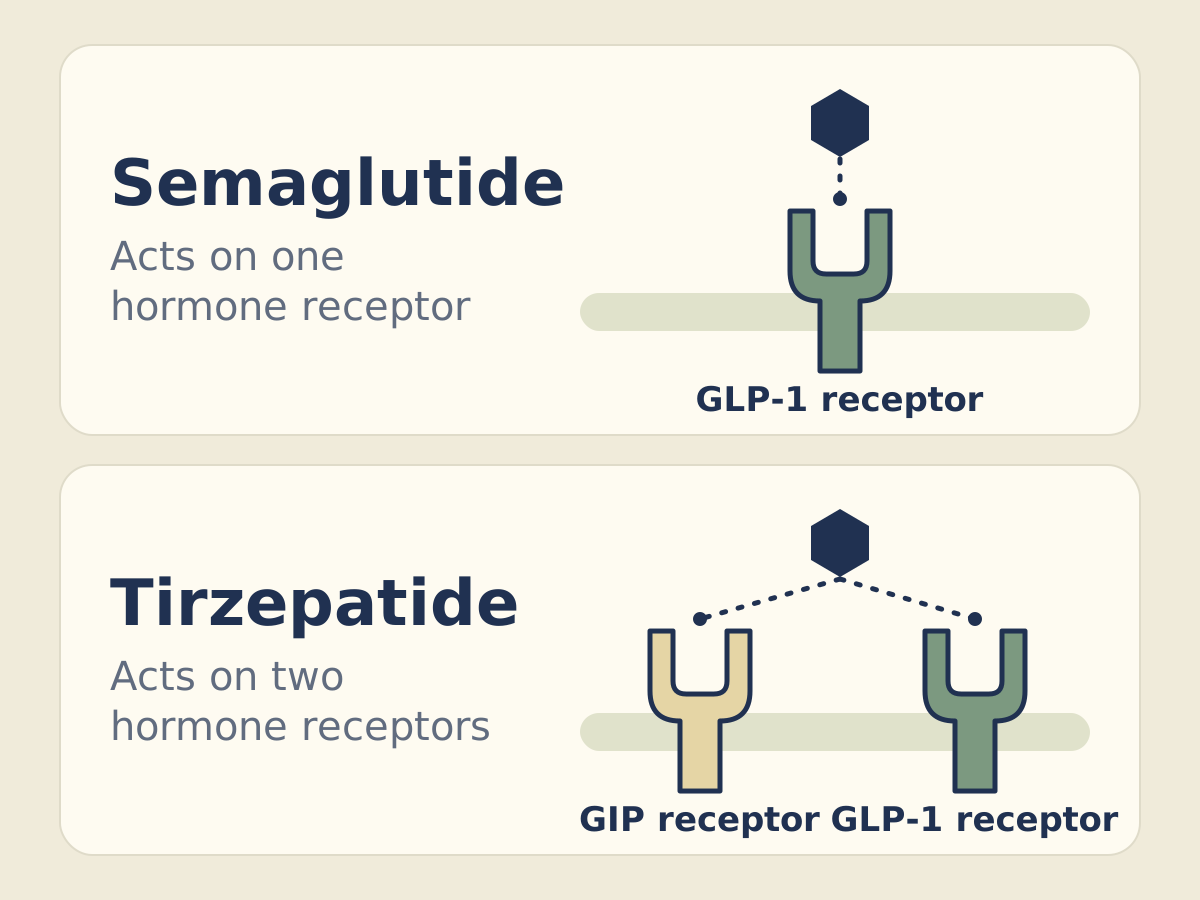
In short: Semaglutide acts on one gut-hormone receptor, GLP-1. Tirzepatide acts on two, GIP and GLP-1. Both are weekly injections with similar, mostly digestive side effects. Increase Health offers compounded semaglutide and compounded tirzepatide, which are not FDA-approved or FDA-reviewed. A licensed provider reviews your online intake and recommends one only if it suits you.
What is the difference between semaglutide and tirzepatide?
They work on different hormone signals. Semaglutide is a GLP-1 receptor agonist: it acts on the receptor for one gut hormone, GLP-1. Tirzepatide is a GIP and GLP-1 receptor agonist: it acts on the GLP-1 receptor and on a second one, for the hormone GIP12. They are different medicines, not two brands of one drug.
Each has an FDA-approved brand for weight management: Wegovy (semaglutide) and Zepbound (tirzepatide). Both are approved for adults with obesity, or with overweight plus at least one weight-related health condition, alongside a reduced-calorie diet and more physical activity12.
What Increase Health offers is compounded semaglutide and compounded tirzepatide. Compounded medications are not FDA-approved, and FDA does not review them for safety, effectiveness or quality. A compounded medicine is not a generic of the brand3.
What did the head-to-head trial compare?
The SURMOUNT-5 trial, published in the New England Journal of Medicine in 2025, compared the two FDA-approved medicines directly in adults with obesity who did not have type 2 diabetes4. Its 751 participants were randomly assigned to one or the other and treated for 72 weeks. In that trial, tirzepatide led to greater average weight reduction than semaglutide4. Individual results vary.
What to know about the design:
- Randomized: chance decided who got which medicine, so the groups started out alike4.
- Open-label: participants and researchers knew which medicine each person was taking4.
- Funded by Eli Lilly, the maker of Zepbound4.
- Doses were adjusted during the trial to the highest level each person could tolerate4.
- Brand medicines only. The trial did not study compounded semaglutide or compounded tirzepatide, so its findings can't be applied to them. Compounded medications are not FDA-approved, and FDA does not review them for safety, effectiveness or quality34.
Do they have different side effects?
Their side effects are much the same. In trials of the FDA-approved medicines, the most common were digestive: nausea, diarrhea, vomiting and constipation, mostly mild to moderate and most likely while the dose was being raised456. In SURMOUNT-5, digestive effects were the most common in both groups4.
A few label differences:
- Both labels carry the same core warnings: the boxed warning about thyroid C-cell tumors, pancreatitis, gallbladder problems, low blood sugar with insulin or sulfonylureas, kidney injury from dehydration, severe stomach side effects, allergic reactions, diabetic eye disease and risks under anesthesia12.
- The Wegovy label also warns that it can raise resting heart rate1.
- The Zepbound label warns that it may make birth control pills less effective for a period after starting and after each dose increase2.
Comparing side-effect rates across separate trials isn't reliable, so we don't. For what helps and when to get care, read our guide to GLP-1 side effects.
How are they taken?
Both are injected under the skin once a week. Your care team and its licensed providers will set the amount and when it changes, and it's printed on your prescription label. The brand medicines come in pens, and Zepbound also comes in vials12. Follow your own label and the instructions that come with your order, not a friend's or a brand's.
- Inject under the skin of your belly, thigh or upper arm, rotating sites1.
- Measure exactly what your label says, with the syringe supplied. FDA has reported serious measuring errors with compounded vials when "units", milliliters and milligrams were mixed up7. Compounded medications are not FDA-approved, and FDA does not review them for safety, effectiveness or quality3.
- Our step-by-step guide covers measuring, sites and storage: How to give yourself an injection at home.
How does a provider choose between them?
There's no single right answer for everyone. A licensed provider looks at your medical history, current medicines, any past experience with a GLP-1 and how you tolerated it, your goals, and practical points like cost. They recommend a medicine only if treatment is appropriate for you, and they may recommend neither.

Things your care team and its licensed providers may weigh:
- Your health history. Thyroid cancer history (medullary thyroid carcinoma or MEN 2), past pancreatitis, gallbladder disease, severe gastroparesis, diabetic eye disease and other conditions all matter128.
- Other medicines. Insulin or sulfonylureas raise the risk of low blood sugar. Birth control pills matter for tirzepatide12.
- Pregnancy plans. Neither is for use in pregnancy. The Wegovy label says to stop at least two months before a planned pregnancy12.
- How you did on one before. Side effects you had and how you tolerated them.
- Cost and availability. The two have different prices (see the table). Tell your care team if price matters to you.
Can I switch from one to the other?
Possibly, but it's a decision for your care team and its licensed providers. Don't switch, combine or convert doses on your own. The labels say not to use either medicine with another GLP-1 receptor agonist12. If you're thinking about switching, message your care team. Its licensed providers will decide whether it makes sense and what to prescribe.
People often ask whether they'd have to "start over". That depends on your situation, and your care team and its licensed providers will explain their plan. Don't use online conversion charts. They will set the amount for whichever medicine you take.
How much do they cost through Increase Health?
As of September 2026, the 3-month starter price is $447 for compounded semaglutide and $669 for compounded tirzepatide. It's one payment with no subscription and no auto-renewal. Your card is authorized at checkout and charged only if a provider approves treatment. If you're not approved, you pay nothing.
- Klarna's four interest-free payments are available at checkout.
- The price covers your first three months. Ask your care team what later supplies cost.
- Compounded medications are not FDA-approved, and FDA does not review them for safety, effectiveness or quality3.
Side by side
Semaglutide | Tirzepatide | |
|---|---|---|
What it is | A prescription medicine used for weight management1 | A prescription medicine used for weight management2 |
How it works | Acts on the GLP-1 receptor1 | Acts on the GIP and GLP-1 receptors2 |
How it's taken | Injection under the skin, once a week, as prescribed1 | Injection under the skin, once a week, as prescribed2 |
Label-studied side effects | Mostly digestive: nausea, diarrhea, vomiting, constipation, belly pain. Label also warns about resting heart rate1 | Mostly digestive: nausea, diarrhea, vomiting, constipation, belly pain. Label also warns about birth control pills2 |
Approved brand versions | Wegovy (FDA-approved for weight management)1 | Zepbound (FDA-approved for weight management)2 |
Available through Increase Health (compounded) | Yes: compounded semaglutide. Not FDA-approved; FDA does not review it for safety, effectiveness or quality3 | Yes: compounded tirzepatide. Not FDA-approved; FDA does not review it for safety, effectiveness or quality3 |
3-month starter price (Increase Health, September 2026) | $447 | $669 |
Side-effect findings come from trials of the FDA-approved brands, not from compounded products.
Questions to ask your care team when choosing
- Given my health history and medicines, is one of these a better fit for me, or neither?
- What side effects should I expect at first, and when should I contact you?
- I've taken one of these before. How does that change your recommendation?
- If I'm not getting on with my medicine, how would we decide whether to adjust or switch?
- Does either one interact with my birth control or my diabetes medicines?
- What will my treatment cost after the first three months?
What people often get wrong
- "Tirzepatide is just a stronger semaglutide." They're different medicines. Tirzepatide acts on a second hormone receptor, GIP, as well as GLP-112. "Stronger" isn't how providers choose; fit is.
- "The head-to-head trial proves compounded tirzepatide works better than compounded semaglutide." SURMOUNT-5 studied the FDA-approved brands only4. It tells us nothing about compounded products, which are not FDA-approved or FDA-reviewed for safety, effectiveness or quality3.
- "The one with bigger trial results must have worse side effects." Both had the same kind of side effects in their trials, mostly digestive and linked to dose increases456. Comparing rates across separate trials isn't reliable.
- "I can switch on my own using a conversion chart." Switching is a provider decision. The labels say not to combine either medicine with another GLP-1 medicine, and your care team and its licensed providers will set the amount for the one you take12.
- "Compounded semaglutide is a generic Wegovy." No. Compounded medicines are not generics and are not FDA-approved3.
When to get help
Adelaida Estrada-Cardenas, M.S.
Chief Strategy Officer & Co-founder
Adelaida holds a Master of Science and has advanced doctoral research training from the UC San Diego School of Biological Sciences and the Salk Institute for Biological Studies. She leads patient education at Increase Health. She is a scientist, not a licensed clinician: your care team and its licensed providers will make every treatment decision.
Related treatments
For adults 18+ in eligible US states. Evaluation does not guarantee a prescription. Only approved patients receive medication; patients pay $0 if not approved. Compounded medications are not FDA-approved.

Compounded Semaglutide
Weekly injection. $447 for 3 months (about $149 a month).

Compounded Tirzepatide
Weekly injection. $669 for 3 months (about $223 a month).
Stylized product images for marketing purposes only; they do not reflect the actual label, size or number of the prescription containers.
Sources
- 1.
- 2.
- 3.
- 4.
- 5.
- 6.
- 7.
- 8.
This guide is general information and doesn't replace advice from your care team. Trial and label findings come from FDA-approved medicines. Compounded medications are not FDA-approved; FDA does not review them for safety, effectiveness or quality.
Related articles
How to give yourself an injection at home
Weight Management · 8 min read

Compounded GLP-1s vs FDA-approved: what's different
Weight Management · 9 min read

What compounded GLP-1 treatment costs: semaglutide and tirzepatide
Weight Management · 5 min read